
If you’ve been researching Kerala, you’ve seen the image a thousand times: a traditional wooden kettuvallam gliding through mirror-still backwaters, framed by palm trees and golden light. It’s one of India’s most iconic travel experiences — and one of its most debated.So is an Alleppey houseboat actually worth it?
The honest answer is: it depends on what you’re hoping to find. For some travellers, it’s a bucket-list moment. For others, it’s an expensive few hours of staring at other houseboats and swatting mosquitoes from a stationary deck.
This guide breaks down exactly what you get, what you don’t, and whether there’s a better way to experience the Kerala backwaters in 2026.
What Is an Alleppey Houseboat? 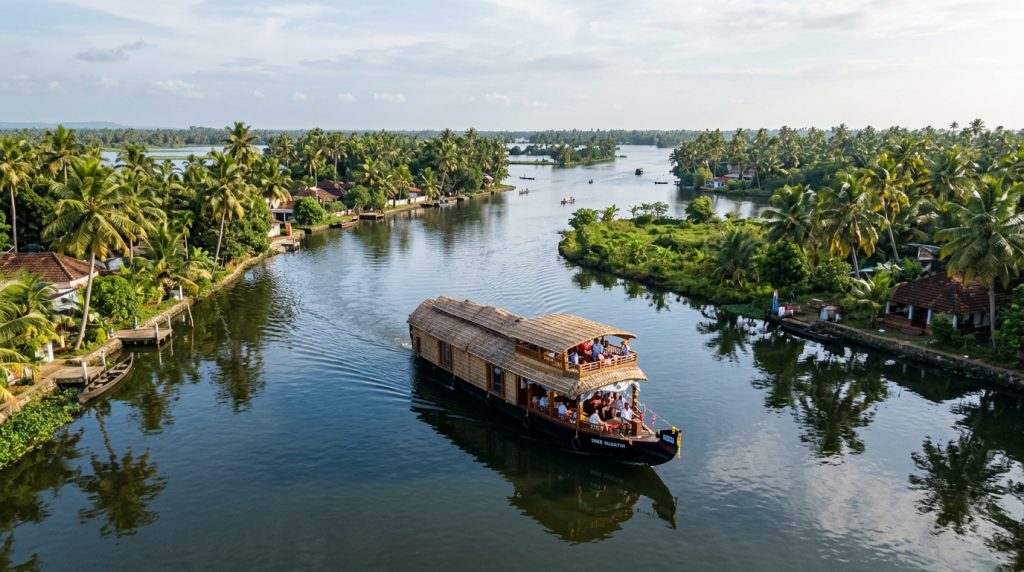
An Alleppey houseboat — locally called a kettuvallam — is a traditional rice barge that has been converted into a floating accommodation. Alleppey (officially Alappuzha) sits at the heart of Kerala’s 900 km backwater network, making it the undisputed capital of houseboat tourism.
Packages typically run overnight: you board around noon, cruise until the boat docks at 4–5 PM, enjoy dinner on board, sleep in one of the cabins, and return to the jetty by morning. A full-day charter with no overnight stay is also available.
Prices range from around ₹8,000 to ₹25,000+ for a one-bedroom overnight package, depending on the operator and level of finish.
Quick verdict: An Alleppey houseboat is a legitimate experience with genuine charm — but it is significantly oversold relative to what you actually get for the money and time invested.
What You Actually Get on an Alleppey Houseboat
Before you book, it’s worth understanding the mechanics of the experience — because the gap between the marketing image and the reality is wider than most travel blogs admit.
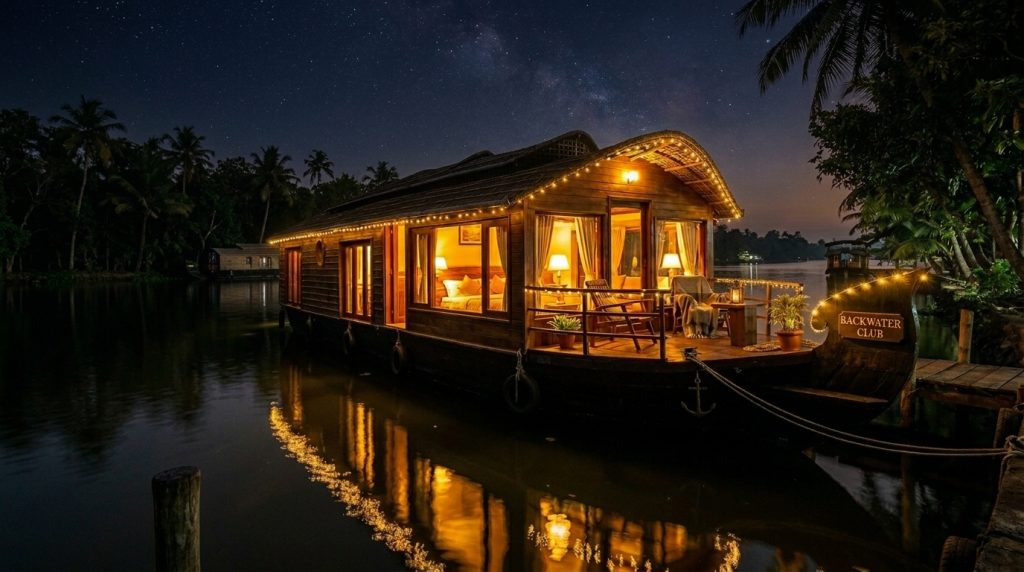
The cruise itself is shorter than advertised. A “full-day” overnight package typically gives you 4–5 hours of actual movement on the water. Boats are required to dock by 5 PM at designated anchoring areas, where they remain until morning. That means if you board at noon, you’re stationary — in a row of other houseboats — for most of your time.
You’re on the main waterways, not the hidden canals. Traditional houseboats are large vessels. They can only navigate the primary, wide waterways — the same routes every other houseboat takes. The narrow village canals, the shaded passages flanked by coconut palms, the spots where local fishermen actually live and work — houseboats simply can’t go there.
The food is generally good. Most operators include meals cooked by an on-board chef, and the Kerala cuisine — fish curry, appam, seafood — is a genuine highlight. This is one area where houseboats consistently deliver.
The setting can still be beautiful. If you catch the right weather, the right time of day, and a quieter stretch of water, the backwater scenery is legitimately stunning. The problem is that peak season can turn the main channels into floating traffic jams.
[Image: View from a houseboat deck showing the main Vembanad Lake channel with multiple other houseboats visible. Alt: Alleppey houseboat on main backwater channel Kerala]
Are Houseboats in Alleppey Overrated?
This is the question more travellers are asking in 2026 — and the evidence suggests: yes, for many visitors, they are.
Here’s what the research actually shows:
Over 1,000 houseboats operate in the Alleppey backwaters. During peak season (November to February), the main channels can look more like a floating parking lot than a serene natural escape. The “tranquil backwaters” you imagined are, in reality, heavily trafficked waterways shared with dozens of identical boats running identical routes.
Pollution is a real and growing concern. Diesel engines, noise, and waste discharge have degraded significant stretches of the backwater ecosystem. Environmental researchers and local conservation groups have flagged the houseboat industry as a leading contributor to backwater pollution. Several sections of the network that were pristine a decade ago are noticeably affected today.
The value equation is poor for solo travellers or small groups. A one-bedroom package typically costs ₹8,000–15,000 for ~4–5 hours of actual cruising. Broken down, that’s a substantial spend for a few hours of passive sightseeing on a crowded waterway, followed by an overnight stay docked between rows of other houseboats.
Reviews are polarised for a reason. Couples celebrating anniversaries tend to love it — the privacy and romance of a floating room are real. Independent travellers who came seeking immersive cultural experiences tend to feel cheated. Both reviews are accurate. They’re just describing different expectations meeting the same product.
The “authentic Kerala” experience houseboats promise is largely inaccessible from a large vessel. The villages, the narrow canals, the morning fishing routines, the traditional toddy shops accessible only by small boat — these are the experiences travellers actually want. They’re almost entirely out of reach from a houseboat.
So the honest answer to “are Alleppey houseboats overrated?” is: overrated as an immersive experience, potentially worthwhile as floating accommodation with good food and scenery. The question is which one you’re actually paying for.
Why Houseboats in Alleppey Are Overrated
Let’s be specific. Here are the structural problems that no amount of good operator selection can fully solve:

1. The Access Problem Houseboats are physically restricted to the main waterways. This isn’t a booking issue — it’s geometry. The narrow canals that define authentic backwater life are simply off-limits to a vessel of that size. You’re watching Kerala from a distance, separated from it by a hull and a railing.
2. The Time Problem The 5 PM docking rule means your cruising window is smaller than the overnight price suggests. You’re paying for the night — but you spend most of it anchored, not moving.
3. The Crowd Problem Peak season transforms the main channels. Travellers consistently report feeling surprised by how many other houseboats are visible at any given time, particularly on Vembanad Lake. The solitude the images promise is rarely available at standard price points.
4. The Environment Problem The diesel engines, waste systems, and sheer volume of houseboats have measurably impacted the backwater ecosystem. Travelling this way carries an environmental cost that quieter alternatives do not.
5. The Passive Experience Problem Sitting on a deck watching scenery pass is pleasant — but it doesn’t generate the kind of vivid, specific memories that make travel meaningful. Most travellers who’ve done both report remembering the kayaking far more clearly than the houseboat.
[Image: Side-by-side comparison: crowded houseboat channel vs. narrow peaceful village canal. Alt: Contrast between main houseboat waterway and narrow backwater canal in Alleppey]
Why Kayaking Is The Better Alternative
If what you actually want from the Alleppey backwaters is intimacy, authenticity, and a genuine encounter with Kerala’s village life — kayaking delivers it in a way that no houseboat can.

Here’s why the experience is categorically different:
You access the backwaters houseboats can’t reach. Kayaks navigate the narrow village canals — passages where you’re close enough to wave to someone cooking breakfast on their doorstep, where the water is framed by overhanging palms rather than open sky, where the silence is actual silence rather than a diesel engine idling. This isn’t marketing language; it’s a function of the vessel’s size.
You’re in the environment, not observing it from above. Sitting at water level changes everything. The smells, the sounds, the sense of being inside the landscape rather than floating above it — kayaking produces an entirely different quality of attention. It’s the difference between watching a documentary and being in the scene.
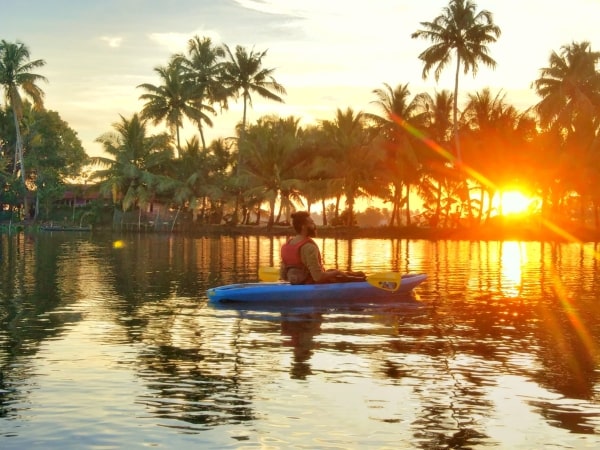
The timing flexibility is a significant advantage. Kayak tours run at sunrise and sunset — the exact windows when houseboats are docked. A sunrise paddle through empty canals with mist on the water is the Kerala backwater experience the postcards promise. Houseboats, anchored by 5 PM, miss it entirely.
It’s lower environmental impact. No diesel engine. No wave turbulence disturbing the ecosystem. Kayaking is the way to experience the backwaters while leaving them intact.
It’s accessible to almost everyone. You don’t need to be a swimmer, an athlete, or an experienced kayaker. A guided tour takes care of instruction, safety, and navigation — you just need to show up.
Why Nadodi Kayaking Is the Best Way to Do It
Not all kayaking tours are equal. If you’re going to do this properly — and experience the backwaters the way they deserve — Nadodi Kayaking is the operator that consistently delivers at the highest level.
Here’s what sets Nadodi apart:
Expert-guided routes through the hidden backwaters. Nadodi’s guides know the network intimately — the routes that other operators don’t take, the spots where the light hits the water correctly at sunrise, the village canals where the scenery is completely unmarked by tourism. The route itself is a curated experience, not a generic loop.
Designed for beginners, calibrated for curious travellers. You don’t need to know how to swim. You don’t need prior kayaking experience. Nadodi’s approach means anyone can participate — and the guided format means you’re not just paddling in circles, you’re actually learning about the ecosystem, the villages, and the culture you’re moving through.
Two tours timed around the best light — and nothing else. Nadodi runs exactly two departures: a Sunrise tour (5:30–8:30 AM) and a Sunset tour (4:00–7:00 PM). These are the only windows worth being on the water — when the light is golden, the canals are quiet, and the backwaters look exactly like the photographs. Houseboats are anchored during both. Nadodi is on the water for both.
Cultural depth built into the experience. Nadodi tours don’t just paddle past things. Stops include local fishing villages, views of traditional toddy shop culture, and encounters with the daily rhythms of backwater life that are genuinely off the tourist track. This is the “authentic Kerala” that houseboat brochures promise and rarely deliver.
A fraction of the houseboat cost for a superior experience. A Nadodi kayaking tour costs a fraction of what a houseboat package charges — and based on what most travellers actually report as their strongest memories from the trip, the kayaking consistently outperforms.
The short version: If the Alleppey houseboat is the tourist experience of the backwaters, Nadodi Kayaking is the real one.
📞 Book your Nadodi Kayaking tour: +91 98472 62585 | nadodikayaking.com

Alleppey Houseboat vs. Kayaking: A Direct Comparison
| Factor | Houseboat | Nadodi Kayaking |
|---|---|---|
| Access to narrow canals | ✗ Main waterways only | ✓ Full backwater network |
| Sunrise / sunset experience | ✗ Docked by 5 PM | ✓ Tours timed for golden hours |
| Cultural immersion | Partial — from a distance | ✓ Eye-level, village-access |
| Environmental impact | High (diesel, waste) | Low (zero-engine) |
| Beginner-friendly | Yes | ✓ Yes — no swimming needed |
| Active experience | Passive | ✓ Active, memorable |
| Cost | ₹8,000–25,000+ | Fraction of houseboat cost |
| Crowd exposure | High (peak season) | Low (narrow canals) |
When a Houseboat Is Worth Booking
In the interest of balance: there are circumstances where a houseboat makes sense.
If you’re travelling as a couple specifically for a romantic overnight experience — a floating room, Kerala food, the sound of water — a good houseboat operator can deliver that. The anchored evening has a certain atmosphere if you’re not expecting wilderness. Choose a premium operator, go off-peak (March–May or September–October), and manage expectations about how much time you’ll actually be moving.
If you have children or family members who are not able to kayak, and you want a shared experience on the water, a day cruise (not overnight) can be a good option at lower cost.
But if you’re travelling to experience the Kerala backwaters in any meaningful sense — to understand what makes this place genuinely special — a houseboat is the wrong vehicle.
Best Time to Visit Alleppey Backwaters in 2026

November to February is peak season — the weather is dry, temperatures are moderate, and the landscape is green from post-monsoon rainfall. It’s also when houseboats are most crowded.
March to May is the shoulder season: fewer tourists, better rates, hotter but manageable. Kayaking is excellent.
June to August (Monsoon) is a polarising but spectacular time to visit. The backwaters are full, the greenery is intense, and the atmosphere is dramatic. Kayaking during a light monsoon morning is one of the most memorable things you can do in South India — houseboats are significantly less appealing in rain.
Frequently Asked Questions
Is an Alleppey houseboat worth the money? For couples seeking a romantic floating stay with good Kerala food, a mid-range to premium houseboat can be worth it. For travellers seeking genuine backwater immersion, the value is poor relative to alternatives like kayaking.
How many hours do you actually cruise on a houseboat? Typically 4–5 hours. Boats dock by 5 PM at designated anchoring areas and remain stationary until morning.
Can beginners kayak in Alleppey? Yes. Operators like Nadodi Kayaking are specifically designed for beginners — no swimming ability required. Guides handle safety and navigation.
What is the difference between a day cruise and overnight houseboat in Alleppey? A day cruise runs for 6–8 hours and returns to the jetty. An overnight package includes accommodation, meals, and the following morning return. Day cruises typically offer better value for time.
Is kayaking in Alleppey safe? Yes, with a professional guided operator. Life jackets are provided, guides are experienced with the route, and the backwater canals are calm water, not open sea.
What is the best time of year to kayak in Alleppey? October to March offers ideal conditions — post-monsoon greenery, comfortable temperatures, and calm water. Sunrise paddles during this window are particularly exceptional.
Are Alleppey houseboats bad for the environment? There are well-documented environmental concerns: diesel emissions, noise pollution, and waste discharge have impacted the backwater ecosystem. Kayaking is a significantly lower-impact way to experience the same waterways.
The Bottom Line
An Alleppey houseboat isn’t a bad experience — but it is a misrepresented one. The gap between the marketing and the reality is large enough that many travellers feel let down, particularly those who came for immersive cultural contact rather than floating accommodation.
The backwaters of Kerala are genuinely extraordinary. The question is how you access them. Kayaking — and specifically, a guided tour with Nadodi Kayaking — puts you inside the landscape that houseboats can only see from a distance.
If you’re visiting Alleppey in 2026, book the kayaking first. Decide about the houseboat second.
📞 Nadodi Kayaking: +91 98472 62585 | Get More Details